


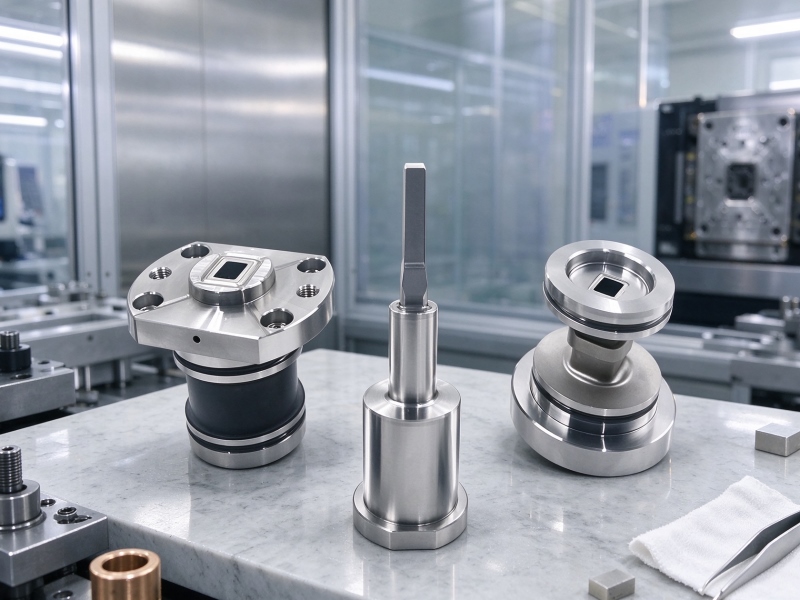
Medical reaction cups are widely used in laboratory testing, diagnostic equipment, and medical analysis systems. Their mold inserts require accurate cavity geometry and smooth surfaces to support consistent product formation and reliable manufacturing. Precision medical reaction cup inserts produced through mirror EDM machining can achieve refined surface finishes while maintaining tight dimensional tolerances. Therefore, understanding how this process works helps mold designers and buyers evaluate its benefits for precision medical molding applications.
Why Do Medical Reaction Cup Molds Require High Surface Quality?
Reaction cups often feature thin walls, small cavities, and detailed internal geometries. During injection molding, surface irregularities inside the mold cavity may transfer to the molded plastic, affecting its appearance and dimensional consistency. In addition, uneven cavity surfaces can influence material flow and make cleaning or product release more difficult. For these reasons, medical mold parts require careful control of machining accuracy and surface quality.
A smooth cavity surface is particularly important when manufacturing transparent or visually inspected reaction cups. Although the final appearance also depends on resin properties, molding conditions, and tool design, the mold surface plays an important role in determining surface replication. Consequently, manufacturers must select machining methods that can produce detailed cavity structures while minimizing surface defects.
How Does Mirror EDM Achieve Optical-Grade Surface Finishes?
Mirror EDM machining uses controlled electrical discharges between an electrode and a conductive workpiece to remove material. Unlike conventional cutting, the process does not rely on direct mechanical contact between the tool and the workpiece. This makes it suitable for machining complex cavities, fine details, and geometries that may be difficult to produce through traditional cutting methods. Furthermore, carefully controlled discharge energy and finishing parameters can produce a highly refined surface.
During finishing operations, smaller and more controlled electrical discharges help reduce surface roughness. However, the final result depends on several factors, including electrode quality, material properties, discharge settings, and the number of finishing stages. For precision medical reaction cup inserts, these controls are important because the cavity must meet both dimensional and surface requirements. The term optical-grade should therefore be understood as a surface-quality target that requires verification against the actual project specification, rather than an automatic result of using mirror EDM.
What Role Do Material Selection and Surface Treatment Play?
The base material affects machining behavior, wear resistance, and the stability of the finished mold insert. Common material options include S136, 420 ESR, 1.2083, and 4Cr13. These stainless steel grades can be considered for different mold applications depending on the required mechanical properties, corrosion resistance, and production environment. Therefore, material selection should be based on the component design and intended service conditions.
In addition to material selection, surface treatment can further influence the finished component’s performance. A composite process combining hard chrome plating and mirror polishing can provide a protective surface layer while improving surface smoothness. Hard chrome plating can help resist mechanical wear, whereas mirror polishing reduces microscopic surface irregularities. Nevertheless, coating thickness and finishing allowances must be controlled carefully to avoid affecting critical cavity dimensions.
Key Factors in Precision Cavity Machining
Producing high-quality medical mold inserts requires coordination between machining accuracy, electrode preparation, cavity geometry, and final inspection. Even when a surface appears highly polished, dimensional deviations or uneven cavity profiles can still affect the molded product. Therefore, manufacturers should evaluate the complete machining process rather than focusing only on the final surface appearance.
The following factors are particularly important:
- Electrode accuracy: Electrode geometry and surface condition directly influence the details transferred during EDM.
- Discharge parameters: Suitable electrical settings help control material removal and improve surface consistency.
- Cavity geometry: Accurate cavity machining supports consistent wall thickness and dimensional stability in molded reaction cups.
- Material compatibility: The selected steel should match the machining process and expected mold operating conditions.
- Final inspection: Surface roughness and critical dimensions should be checked against the agreed technical requirements.
These factors work together to achieve reliable results. In particular, micro mold inserts with small features require careful control of electrode dimensions and machining conditions because minor deviations may have a noticeable effect on the finished cavity.
Mirror EDM Compared with Conventional Cavity Machining
Different machining methods serve different purposes in mold manufacturing. Conventional cutting and grinding are useful for material removal, dimensional preparation, and surface finishing, while mirror EDM is particularly valuable for complex conductive cavities and fine details. As a result, manufacturers may combine several processes to achieve the required geometry and surface quality.
| Evaluation Factor | Conventional Machining | Mirror EDM Machining |
|---|---|---|
| Material Removal | Uses mechanical cutting or grinding | Uses controlled electrical discharges |
| Tool Contact | Mechanical contact occurs during cutting | No direct cutting contact with the workpiece |
| Complex Cavity Details | Depends on tool access and geometry | Suitable for complex conductive cavity features |
| Surface Finish | Depends on cutting and polishing processes | Can achieve refined finishes through controlled finishing stages |
| Typical Application | Basic shaping and dimensional preparation | Detailed cavities and fine mold features |
| Process Considerations | Tool wear and cutting forces | Electrode accuracy and discharge parameters |
The most suitable process depends on the component geometry, material, tolerance, and required surface finish. In many cases, combining machining methods provides better overall process control than relying on a single operation.
Manufacturing Specifications and Quality Control
For buyers sourcing precision medical mold inserts, clear manufacturing specifications help establish measurable quality requirements. Chuanchen Precision provides mirror EDM processing with several material options and defined machining capabilities. The following specifications offer a reference for evaluating component requirements and manufacturing suitability.
| Item | Provided Specification |
|---|---|
| Processing Type | Mirror EDM |
| Materials | S136 / 420 ESR / 1.2083 / 4Cr13 |
| Tolerance | ±0.001 mm |
| Maximum Diameter | 300 mm |
| Maximum Machining Size | 800 mm |
| Surface Roughness | Ra 0.05 μm |
| Surface Treatment | Hard Chrome + Mirror Polishing Composite |
For precision medical reaction cup inserts, dimensional inspection and surface measurement should be included in the quality control plan. Buyers should also clarify whether the specified Ra 0.05 μm applies before or after surface treatment, particularly when coating thickness may influence final dimensions. In addition, the inspection method and measurement locations should be agreed upon before production begins.
How to Choose a Manufacturer for Custom Medical Mold Inserts?
Selecting a suitable manufacturer involves more than checking the available machining equipment. Buyers should review the supplier’s experience with complex cavity structures, material processing, EDM finishing, and dimensional inspection. Furthermore, technical drawings should clearly identify critical dimensions, surface requirements, tolerances, and any coating specifications. This information helps manufacturers determine the appropriate machining sequence and inspection procedures.
Chuanchen Precision offers mirror EDM and precision mold machining based on customer drawings and project requirements. With material options including S136, 420 ESR, 1.2083, and 4Cr13, the manufacturing process can be evaluated according to different component designs. Its stated capabilities include a maximum diameter of 300 mm, a maximum machining size of 800 mm, and a tolerance of ±0.001 mm. These specifications provide a basis for discussing custom medical mold inserts and related cavity machining projects.
Conclusion
Mirror EDM is a valuable process for producing complex mold cavities that require fine details and refined surface finishes. By controlling electrode quality, discharge parameters, material selection, and final inspection, manufacturers can improve the consistency of precision mold components. In addition, suitable surface treatments can provide further protection when the component design and coating requirements allow. Ultimately, precision medical reaction cup inserts require a balanced approach to cavity accuracy, surface quality, and manufacturing control to support reliable medical molding applications.
