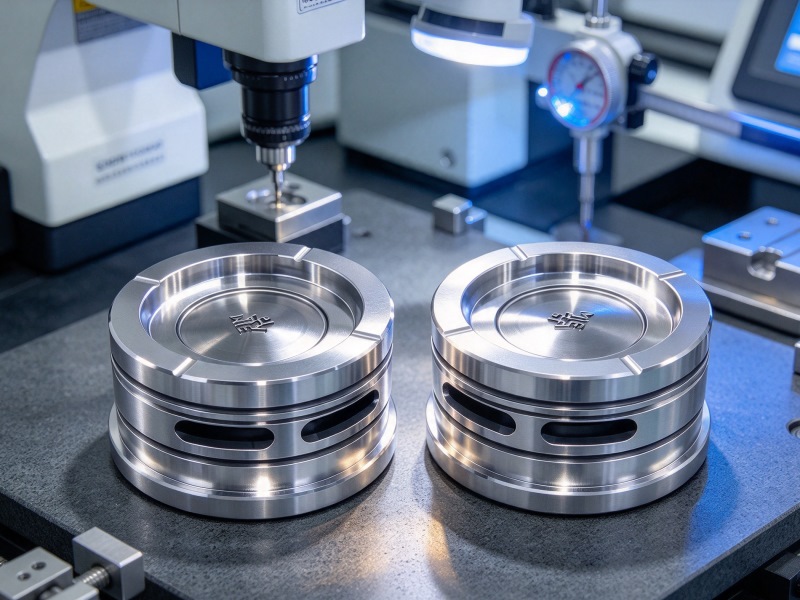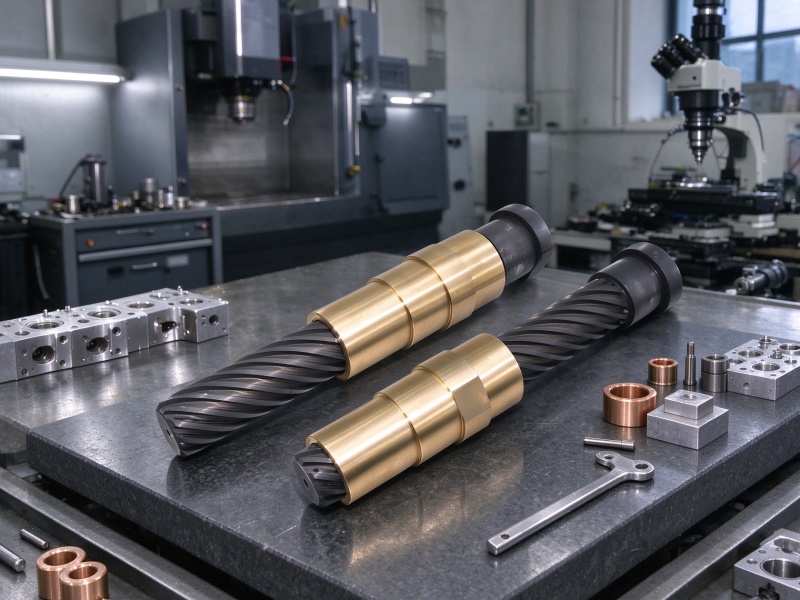
Bottle caps often contain internal threads that must fit securely onto bottle necks while remaining easy to open. During injection molding, these threads create additional demolding challenges because the molded cap cannot always be released through a simple straight-pull mechanism. Bottle cap unscrewing mold parts help solve this problem by allowing threaded components to rotate and release the molded cap without damaging its internal thread structure. Therefore, precision CNC turning plays an important role in producing components that support accurate thread formation and smooth demolding.
Why Do Bottle Cap Molds Require Unscrewing Mechanisms?
Threaded bottle caps need precise internal geometry to ensure proper engagement with bottle necks. However, once the plastic material cools and solidifies around the threaded core, direct ejection may cause deformation, scratches, or thread damage. An unscrewing mechanism addresses this issue by rotating the threaded core or related mold components before the cap is fully ejected. As a result, the molded product can separate more smoothly while maintaining its designed thread profile.
The mechanism typically includes threaded cores, rotating components, drive elements, and supporting mold structures. Each part must work together with accurate alignment and controlled movement. Furthermore, small dimensional errors can affect thread engagement, rotation resistance, and the consistency of finished caps. For this reason, manufacturers need reliable machining processes to produce bottle cap mold parts with accurate dimensions and stable mechanical performance.
How Does Precision CNC Turning Improve Thread Accuracy?
CNC turning is particularly suitable for manufacturing cylindrical components, threaded cores, and other rotational mold elements. During machining, the cutting tool follows programmed paths to remove material and create the required diameter, profile, and surface geometry. Compared with manual machining, CNC turning provides repeatable control over critical dimensions and helps maintain consistency across production batches. Consequently, it is an important process for manufacturing components that require close tolerances.
For bottle cap unscrewing mold parts, thread accuracy directly affects how smoothly the molded cap releases from the core. Incorrect thread dimensions or uneven surfaces may increase friction during rotation and create additional stress on the molded plastic. With a specified tolerance of ±0.001 mm, precision machining can support close dimensional control when the component design and inspection method are properly defined. In addition, a surface roughness of Ra 0.05 μm helps provide a refined finish for applications where surface contact and movement are important.
Why Do Surface Treatment and Material Selection Matter?
Machining accuracy is only one part of the manufacturing process. Material selection and surface treatment also influence how mold components perform under repeated contact, pressure, and operating cycles. Common material options for these components include S136, 420 ESR, 1.2083, and 4Cr13. Each material should be selected according to the required mechanical properties, operating environment, and compatibility with the specified finishing process.
A composite treatment combining hard chrome plating and mirror polishing can further improve the finished surface. Mirror polishing reduces microscopic surface irregularities, while hard chrome plating provides an additional protective layer that can help resist mechanical wear. Moreover, a smoother surface may reduce friction during contact between moving components, depending on the operating conditions and lubrication. Together, these processes help support the performance requirements of precision mold components.
Key Factors That Affect Smooth Thread Demolding
Smooth demolding depends on the coordination of machining accuracy, thread geometry, surface quality, and the unscrewing mechanism. Even when individual parts meet their dimensional requirements, poor alignment or unsuitable operating parameters can still affect the release process. Therefore, engineers should evaluate the complete mechanism rather than focusing on a single component.
The following factors deserve particular attention during manufacturing and mold design:
- Thread profile accuracy: Correct thread dimensions help maintain consistent engagement between the molded cap and the threaded core.
- Concentricity and alignment: Accurate rotational geometry helps reduce uneven contact and unnecessary resistance during unscrewing.
- Surface roughness: A refined surface can reduce friction and help prevent unwanted marks on contact areas.
- Material compatibility: Suitable steel grades support the required strength, wear behavior, and surface treatment.
- Machining consistency: Repeatable CNC processes help maintain dimensional stability across multiple production batches.
These factors work together to improve demolding consistency. In particular, accurate CNC turning helps establish the geometry needed for the remaining assembly and finishing operations.
CNC Turning Parts: Important Manufacturing Specifications
Different mold designs require different component dimensions and machining arrangements. The following specifications provide a reference for evaluating manufacturing capabilities and processing requirements.
| Evaluation Item | Provided Specification | Manufacturing Significance |
|---|---|---|
| Processing Type | CNC Turning | Produces cylindrical and rotational geometries |
| Materials | S136 / 420 ESR / 1.2083 / 4Cr13 | Supports different mold component requirements |
| Tolerance | ±0.001 mm | Enables close dimensional control |
| Maximum Diameter | 300 mm | Defines the maximum diameter capacity |
| Maximum Machining Size | 800 mm | Indicates the available machining size |
| Surface Roughness | Ra 0.05 μm | Supports refined surface finishing |
| Surface Treatment | Hard Chrome + Mirror Polishing Composite | Adds surface refinement and wear protection |
These specifications are useful when reviewing CNC turning parts for threaded mold applications. However, the final manufacturing plan should still follow the component drawings, thread dimensions, and assembly requirements. In addition, inspection should verify critical diameters, thread geometry, surface finish, and other specified tolerances.
How to Select a Manufacturer for Custom Demolding Mechanisms?
Choosing a suitable manufacturer involves more than comparing machining prices. Buyers should confirm whether the supplier understands threaded mold structures and can maintain the required accuracy throughout machining and finishing. It is also important to review equipment capacity, material options, inspection procedures, and experience with mold tooling components. These considerations help reduce dimensional inconsistencies and improve compatibility during mold assembly.
Chuanchen Precision provides CNC turning and precision machining for custom mold components. With material options including S136, 420 ESR, 1.2083, and 4Cr13, the manufacturing process can be evaluated according to customer drawings and technical requirements. Its stated machining capabilities include a maximum diameter of 300 mm, a maximum machining size of 800 mm, and a tolerance of ±0.001 mm. Furthermore, the composite hard chrome plating and mirror polishing process supports projects requiring refined surface finishes.
Conclusion
Smooth thread demolding requires accurate thread geometry, reliable rotational movement, and suitable surface finishing. CNC turning helps produce consistent cylindrical and threaded features, while material selection and composite surface treatment contribute to the overall performance of the mold components. By coordinating these manufacturing processes, bottle cap unscrewing mold parts can support more consistent release of threaded caps and help reduce the risk of surface damage. Therefore, buyers should evaluate machining accuracy, finishing capabilities, and dimensional inspection when sourcing components for custom demolding mechanisms.